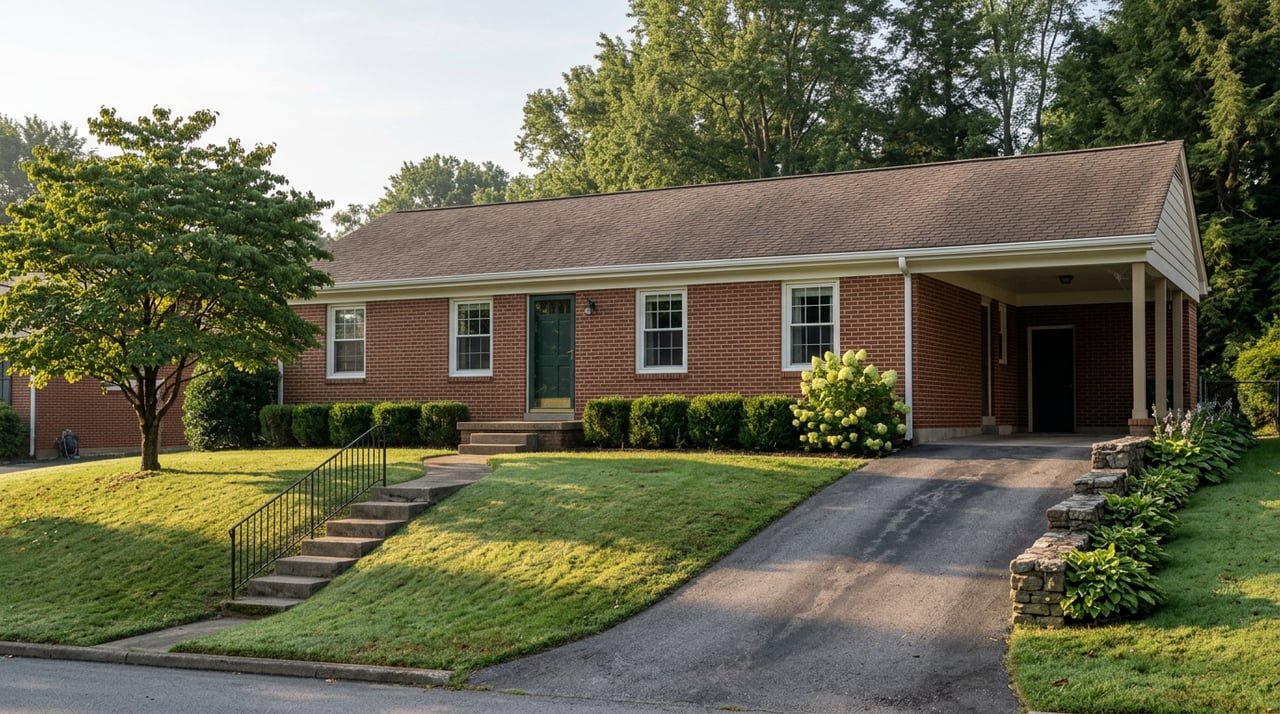
Huntington's Median Home Price Is Averaging Two Cities That Don't Compete
September 3, 2026
September 3, 2026
Search "Huntington WV home prices" and you'll land on a single number. Depending on which live valuation tool you land on, that number could be $114,148 or $144,412, and both figures come from Zillow's own home value index within the last few months of 2026. That spread alone should tell you something is wrong with treating Huntington as one market. It isn't a pricing disagreement between data providers. It's a symptom of averaging together two housing markets that rarely bid against each other for the same house.
One of those markets runs on rental demand generated by Marshall University and St. Mary's Medical Center. The other runs on family buyers who compete for owner-occupied homes near Ritter Park, Rotary Park, and the hillside neighborhoods east of downtown. A citywide median doesn't split the difference between these two markets so much as it papers over the fact that they exist.
If you're comparing a listing in Highlawn to a listing in Beverly Hills using price per square foot alone, you're comparing two different economies, not two homes.
Highlawn sits a short walk from St. Mary's Medical Center, with early 20th-century bungalows and foursquare homes lining quiet, straight-line blocks, some still paved in brick. Staunton Road homes look out over the Ohio River. Fifth Avenue carries the neighborhood's commercial strip, a mix of grocery stores, auto parts shops, and local restaurants. On paper it reads like a walkable, historic neighborhood that should command a premium.
It doesn't. Homes.com puts Highlawn's median home price at $119,250, with the average sale price over the trailing twelve months at $140,198, itself up 14 percent from the prior twelve-month stretch. Homes there sell after an average 53 days on market, slightly slower than the roughly 46-day national average the same source reports. A few blocks south, Highlawn South carries an even lower median, $102,895 as of NeighborhoodScout's early 2026 neighborhood data, with most of the housing stock renter-occupied rather than owner-occupied.
The reason isn't neglect or decline. It's proximity. A hospital and a university generate a steady, structural pool of tenants: staff, students, traveling nurses, short-term residents. Investors buy into that pool for the rental income, not for owner-occupant appreciation, and their offers are built around cap rate math rather than comparable-sale competition. That keeps a lid on what a home in Highlawn can fetch even when the bones of the house and the walkability of the block would command more money three miles east.
West Huntington shows how extreme this gets at small sample sizes. Redfin's neighborhood page reports a median sale price of $75,000 over the three months ending April 2026, up 108 percent from the same period a year earlier, with homes taking an average of 99 days to sell against 168 days the year before. A 108 percent swing isn't a market repricing itself. It's what happens when only 15 homes sell in a stretch and the mix of what happened to close shifts the median wildly. Small neighborhoods produce numbers like this constantly, and treating any single month's median as gospel in a market this size is a mistake buyers and sellers both make.
Drive east and the story flips. Southeast Hills, a neighborhood of homes ranging from 800 to over 8,000 square feet on lots that sometimes exceed half an acre, posted a median sale price of $201,200 over the trailing twelve months tracked by Homes.com, up 12 percent year over year. Roughly three in four residents there own rather than rent. The neighborhood sits close enough to Ritter Park, a 75-acre park with a rose garden, fountain, and hiking trails that the American Planning Association has recognized among the country's top public spaces, that proximity to the park functions as a real pricing input, not just a lifestyle detail.
Southside tells a similar story with sharper acceleration. Redfin's May 2026 data put the median sale price there at $219,926, up 25.7 percent year over year, a pace that outstrips nearly every other neighborhood in the city.
Beverly Hills sits at the top of this tier. The most recent neighborhood-level estimate available, compiled in 2025, put the median there at $334,570, in a housing stock that's overwhelmingly owner-occupied rather than rented. The neighborhood anchors around Norway Avenue, where the Beverly Hills Presbyterian Church, Guy's Farm & Yard Center, and a stretch of local shops give the corridor its commercial spine, while St. Cloud Commons Park and the walking path along Norway Avenue give residents the kind of green space that shows up in listing photos rather than listing descriptions. Beverly Hills Elementary sits on Washington Boulevard as the neighborhood's institutional center, the kind of anchor that draws family buyers rather than transient renters.
Here's the comparison laid out directly:
| Neighborhood | Recent median price | Occupancy pattern | What's driving it |
|---|---|---|---|
| Highlawn South | $102,895 | Majority renter-occupied | Marshall University proximity, investor cap-rate buying |
| Highlawn | $119,250 | Hospital-adjacent, renter-leaning | St. Mary's Medical Center proximity, rental demand |
| West Huntington | $75,000 (3-month, small sample) | Volatile, low sale volume | Thin market, wide swings on few closings |
| Southeast Hills | $201,200 | Majority owner-occupied | Ritter Park proximity, family buyers |
| Southside | $219,926 | Owner-occupied, fast-rising | Strong recent buyer demand |
| Beverly Hills | ~$334,570 | Predominantly owner-occupied | Established family neighborhood, park access, church and school anchors |
Notice that the price gap between the bottom and top of that table is roughly threefold, inside one city, inside a single MLS. That gap is the whole point. A citywide figure sitting somewhere between $114,000 and $144,000, depending on the month and which Zillow data cut you land on, isn't a snapshot of Huntington's housing market. It's a blend of two markets that hardly ever put in competing offers on the same house.
The practical risk shows up at the appraisal, not the offer. An agent or an automated valuation model that pulls comps carelessly, grabbing a Highlawn sale to support a Southeast Hills listing, or the reverse, will produce a number that doesn't hold up. Lenders catch this. Appraisers catch this. And a buyer who has already gone under contract on a home priced against the wrong comp set can find themselves scrambling to cover a gap between contract price and appraised value.
If you're weighing neighborhoods against each other, a few questions do more work than the median ever will:
None of this means Highlawn or Highlawn South are bad places to buy. For an investor comfortable underwriting to rental income, the lower entry price and steady tenant pool near two large institutional employers can be exactly the play. For a family buyer trying to build equity in an owner-occupied market, though, pricing a Beverly Hills or Southeast Hills purchase off a Highlawn comp, or vice versa, will produce a number that has nothing to do with what either house will actually sell for.
That's the piece the median leaves out. It isn't lying. It's just describing an average of two cities that happen to share a zip code, a school district, and a name.
If you're weighing a move within Huntington, whether that's a first purchase near the hospital corridor or a step up into the Ritter Park side of town, Christina and David Di Filippo at Home in WV can walk you through which comps actually apply to the block you're looking at. Schedule your free consultation and get a read on the market that starts with the right neighborhood, not the citywide average.
Whether you’re ready to sell your home, curious about its value, or just exploring your options, Christina and David Di Filippo are here to guide you. Let’s connect and start turning your real estate goals into reality.