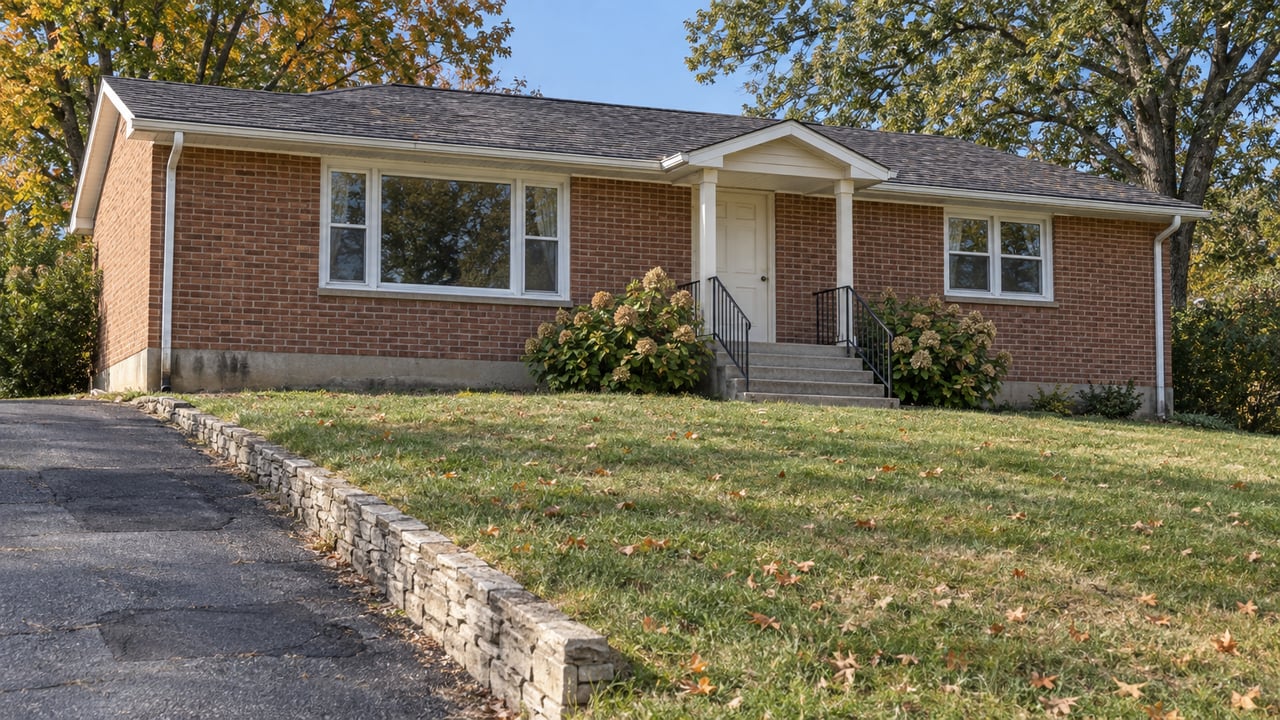
Greenbrier County Is Rewriting the Rules Around Lewisburg. What Does That Mean for the Land You're Eyeing?
October 8, 2026
October 8, 2026
"Nonconforming lots, structures, or uses may continue to exist, be bought or sold, altered, restored, or extended only in accordance with the provisions of this code."
That sentence from Greenbrier County's August 2026 draft zoning ordinance answers a question residents raised at the packed March hearings: does a grandfathered use survive when someone buys or inherits the property? Under the draft, it does. The same article of the draft also sets a clock, and that clock matters most to anyone buying land, a farmhouse, or an estate property outside Lewisburg's city limits this fall.
The draft says that if a nonconforming use has stopped for one year, abandonment is presumed and the use cannot resume. From then on, any use of the land has to follow the new ordinance. The draft lists conditions that trigger that presumption, including:
Once a nonconforming use has been converted to a conforming one, it cannot go back.
Here is how that plays out in a transaction. Estate sales and long-vacant properties are exactly the ones where utilities get shut off and use stops for months. Say a buyer is paying for a small shop, an older outbuilding use, or some other grandfathered arrangement on a rural parcel. That buyer needs to know when the use last ran, not only that it once existed. The County Commission also struck an earlier trigger that would have ended a nonconforming use when a County business license expired.
None of this reaches most of Greenbrier County. At the March hearings, Commissioner Richie Holliday noted that less than 10 percent of the county's land is zoned and that the rewrite wouldn't change that. The Lewisburg and Fort Springs areas are the only two regions the zoning ordinance affects. The current county code describes its territory as the unincorporated areas of the Lewisburg and Fort Spring tax districts, and it uses a zoning map from 1999. The rewrite keeps the existing districts and the existing map.
So "near Lewisburg" can mean three different rulebooks:
The second group is where homes and businesses sit closest together. At the September 15 hearing, Commissioner Lowell Rose pointed to Fairlea, Fort Spring, and Caldwell as places with different land-use concerns because homes, businesses, and other properties are close together. In July, Rose urged residents to review the proposal to see whether it would affect their property. Buyers should do the same.
The latest full text on the county's document center is labeled "DRAFT Updated Zoning Ordinance w/ CC revisions 8/2026" and dated August 18, 2026. That draft is the closest thing to a current rulebook. Here is how it treats the uses second-home and acreage buyers bring up most:
| Use | What the August 2026 draft says |
|---|---|
| Short-term rental | Conditional use in Residential, Open Space Conservation, and Forest Recreation, which means Board of Zoning Appeals review. Permitted in Commercial. Not listed in Industrial. |
| Short-term rental limits | No more than six sleeping areas and 18 overnight guests. The BZA may set a lower limit. No reception or event facility unless that use is separately allowed. Must meet state fire marshal, building code, and health department rules. |
| Recreational vehicle | A licensed, road-ready RV may be used for "temporary, recreational or seasonal living," but not as an alternative dwelling unit or a short-term rental. It must meet district setbacks. |
| Inoperable RV | Cannot be occupied or stored outdoors in the Residential district. |
| Accessory dwelling unit | Must be secondary to a single-family dwelling. One per lot of record. |
The short-term rental row matters most for buyers planning a rental. Outside Commercial, renting by the night is a conditional use, so it depends on a BZA permit for that specific property. The permit can also cap how many guests the property hosts. A buyer whose numbers depend on a weekend rental is really buying a permit application.
An independent review of the March County Commission markup described the ADU as attached, detached, or internal, capped at 50 percent of the primary dwelling's square footage. The August definition doesn't repeat that cap, so check the size limit in the final text before you plan a guest cottage.
An independent comparison of the proposed text against the 2003 code also reports smaller minimum lots in the Residential district. With public water and sewer, the minimum drops from 20,000 to 12,000 square feet. With water only, it drops from 30,000 to 20,000. Without either, it drops from one acre to three-quarters of an acre. Open Space Conservation stays at two acres. If those numbers hold, some parcels in the zoned area could be subdivided in ways the current code doesn't allow.
Since the Planning Commission sent its version over, the County Commission's changes have mostly removed restrictions. The flat ban on living in an RV became the seasonal allowance described above. Home-business customer hours moved from 6 p.m. to 9 p.m., and the eight-visits-per-day cap was deleted. So was the express allowance for one employee who doesn't live in the home. Agritourism lost its five-acre minimum, its on-site-products-only rule, and its 10 a.m. to 9 p.m. operating window. The commission also added "equine" to the definition of an agricultural operation.
Those changes respond directly to the March testimony. Joshua Bennett, owner of Hawk Knob Cidery and Greenbrier Valley Brewing Company, said the original draft would be "way more restrictive" than state law for his cider business. Taso Stavrakis of Hollow Hills Farm, home of the West Virginia Renaissance Festival, and Susan Graham of Fair Haven Equine and Event Center both noted that horse farms weren't specifically listed in the farm definitions. Commissioners said in July that they removed provisions they felt would require too much enforcement, and that they added conditional uses the BZA could review case by case.
The same flexibility applies to the property next door. The March markup added conditional uses to the Residential district, including bakeries, catering businesses, event facilities, and retail shops. In September, speaker Linda Ball asked "whose property rights" are at stake, noting that commercial uses can affect neighbors through traffic, noise, and lighting. For a buyer, the conditional-use list for a district describes what could open next door as well as what you could do yourself.
We haven't seen anything confirming that the full replacement has been formally adopted or naming an effective date. The effective-date line in the August draft is still a placeholder.
Can I rent out a home near Lewisburg by the night? Inside the county's zoned area, the August draft makes short-term rentals a conditional use in Residential, Open Space Conservation, and Forest Recreation, and a permitted use in Commercial. Outside the zoned area, county zoning doesn't apply. Inside city limits, Lewisburg's own code governs.
Can I live in an RV while I build? The August draft allows a licensed, road-ready RV for temporary, recreational, or seasonal living. It can't serve as a second dwelling or a short-term rental.
Does the new ordinance apply to farms? The County Commission's version adds a preemption section saying the ordinance doesn't apply where state or federal law occupies the field, and it names agricultural operations. How that applies to a specific operation is a question for the county or an attorney.
Christina has served on planning bodies, so she reads drafts like this one closely. If you're weighing land or a second home outside Lewisburg and want to know which rulebook covers it before you make an offer, Christina Difilippo can walk through the parcel, the district, and the latest county text with you. Schedule your free consultation.


Whether you’re ready to sell your home, curious about its value, or just exploring your options, Christina and David Di Filippo are here to guide you. Let’s connect and start turning your real estate goals into reality.